
Conway Previous Residents Sources
Previous residents of a Conway address are best traced in source eras. Current property tools provide the parcel key that anchors later work. The Horry County Register of Deeds then connects recorded parties to legal descriptions, book and page locators, document types, and record dates. Historic Conway directory references supply dated address leads, while census schedules can add household context. Sanborn maps place a building or street in its physical setting. Each source answers a narrower question, so a careful trail moves from one to the next instead of treating an address search as a complete occupant list.
| Source | Years it covers | Where held | What it can show |
|---|---|---|---|
| Horry ROD online party-name results | 1984 forward | Acclaim, counter, or copy request | Recorded-party trail and official-record search routes |
| Earlier Horry land records | Before the online cutoff; exact volume years require confirmation | ROD counter, SC Archives, and FamilySearch catalog | Older deeds, plats, and grantor/grantee indexes |
| Horry probate records | 1803-1873 confirmed in the FamilySearch catalog | Archival channels; Probate Court for current files | Estates, wills, fiduciaries, and heirs |
| Conway city directories | 1939; 1959-1971; 1966 | Verify a volume with HCML or Thompson Heritage | Dated person, business, or address lead |
| Sanborn maps | 1920, 1930, 1938, and 1949 anchors | Library of Congress and cited collections | Street and building context, not resident names |
| Federal census | SC Archives access 1790-1930; later schedules follow 72-year release | South Carolina Archives research room | Household and neighborhood context |
| City building and permit system | Current online portal; historic coverage not located | City BS&A or focused records request | Permit or inspection timing when a record exists |
Start with the period you need. A 1984 or later ownership lead may begin online. An early twentieth-century question is more likely to require archives, directories, maps, probate, or census material. A source that places a person near an address is a lead to test, not automatic proof of residence.
Conway Previous Residents Start With Parcels
For a Conway house history, use Horry County Tax Payer Services to begin with the current tax or parcel route. Its main control is labeled “Name or Pin or Address.” Preserve the PIN or TMS and the legal description when the authorized record makes them available. A situs address is the physical parcel location; a mailing address can be a post-office box or another place. A property owner may be an individual, trust, business, estate, or association. Those distinctions prevent a current tax record from being mistaken for a list of everyone who lived there.
Horry County Tax Payer Services is the source for the visible search control and the parcel-first starting point. Horry County began requiring a free user login on March 16, 2026 for online GIS, Land Records, and Tax and Assessor platforms that display property-address information. Plan for that access step. If the web route does not answer the question, use the relevant county custodian, counter, or request channel instead of promising anonymous online access.
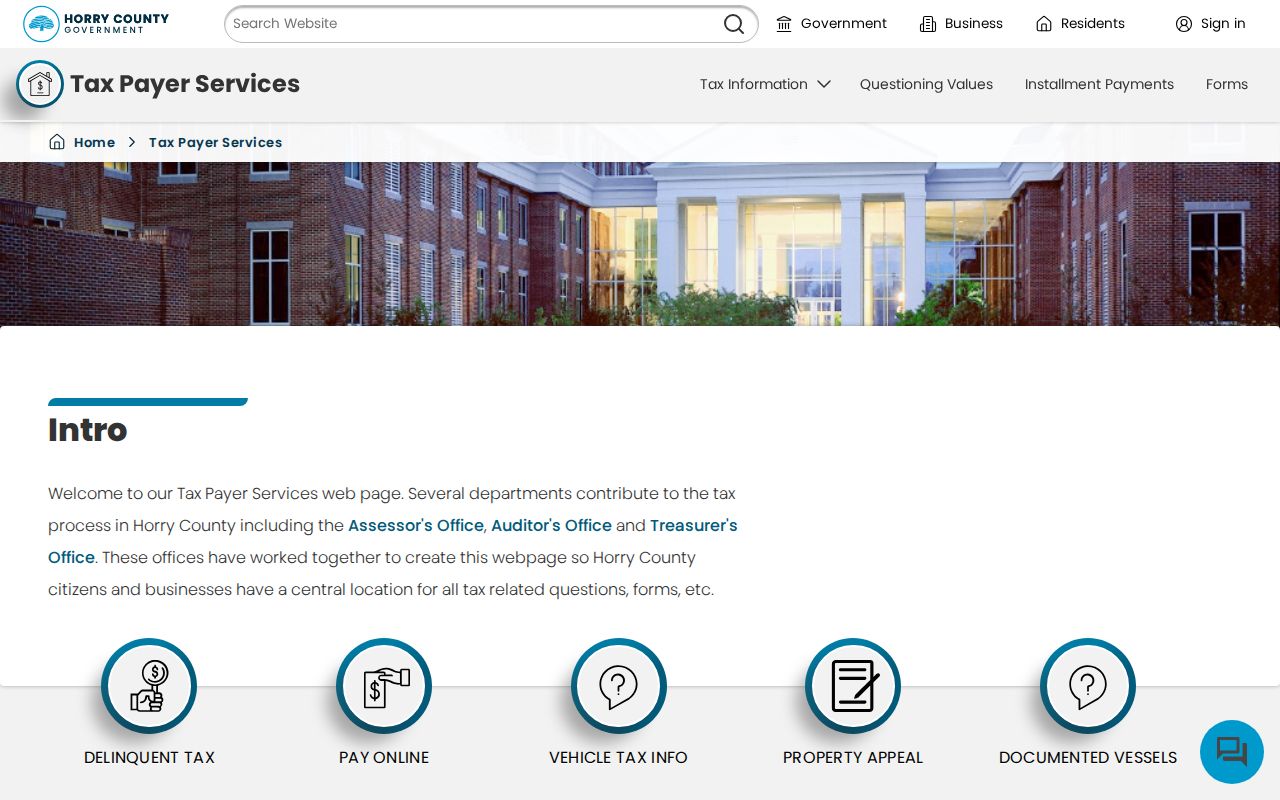
The visible search label is useful for establishing the parcel key, while the account requirement and unverified parcel-card fields set clear limits on what an online result can establish.
Note: Match the legal description or lot before linking old records because the same street name alone may not identify the same Conway parcel.
Conway Previous Residents and 1984
Horry County Records Search is the modern doorway to Official Records. The Register of Deeds copy form states that online name results reach 1984 forward. Its search modes include party name, book and page, parsed legal description, legal-description or memo text, document type, consideration range, and record date. For party searching, the form directs users to enter last name first, with no punctuation, and to search spelling variants. The landing page is not proof of a fully open image archive: account access and purchased-document redaction limits affect use.
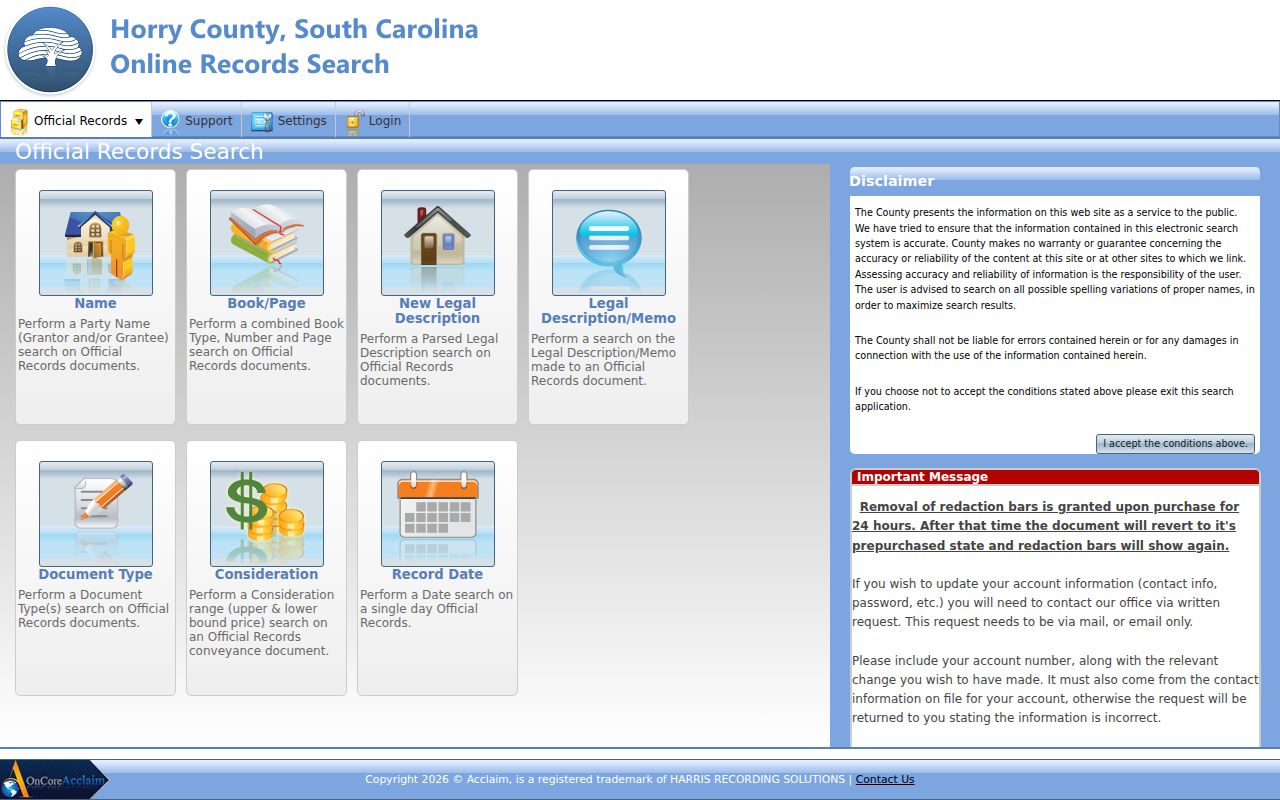
The official-record modes offer several ways to locate an instrument after a current parcel or prior deed supplies a party name, legal description, or book and page.
Earlier than the confirmed online line, contact the Register, visit the counter, use the copy-request form, or consult South Carolina Archives county-record microfilm and the FamilySearch catalog. The Register's normal-copy charges are $8 for the first four pages and $1 for each additional page. A certified legal copy adds $2; small and large plats have separate published prices. The form gives no turnaround estimate, so none should be assumed.
Conway Previous Residents: Horry Deed Chain
A deed chain follows property parties backward, not a household roster. Begin with the present parcel key and legal description, then find the current owner's acquisition instrument. That instrument identifies a prior grantor. Search that person as a potential earlier grantee, then test the legal description, subdivision, or lot against the new result. Keep book and page, date, and document type with each step. A matching street address alone is weak evidence when plats, subdivisions, or municipal boundaries have changed.
- Use the current property route to preserve the PIN or TMS and legal description.
- Search Acclaim using the best available party, legal-description, book/page, or record-date key.
- Read the acquisition document and identify the earlier grantor.
- Search that grantor as a possible grantee in an earlier acquisition, then compare the legal description.
- Repeat backward, moving to the Register counter or archival indexes before the confirmed online name-search period.
- Grantor and grantee
- A grantor transfers an interest in property. A grantee receives that interest in the recorded instrument.
- Chain of title
- The sequence of recorded transfers used to connect an interest in one parcel through time.
- Legal description
- The recorded parcel description, such as a lot or subdivision reference, which is often more stable than an old street address.
A mailed Register request can include the name on the document, document type, book and page, PIN or TMS, property address, and brief description. Giving several locators helps staff select the intended record.
Conway Previous Residents in 1938
The Library of Congress digitized July 1938 Conway Sanborn map has nine sheets. The state survey also cites Conway maps for 1920, 1930, 1938, and 1949. Use a sheet to see a street, building footprint, or building-use context close to a directory era. It cannot identify the people who lived inside. The safer chain is a map sheet paired with the closest directory reference, then a deed, plat, or legal description that tests the parcel connection.
The documented Conway city-directory points are 1939, 1959-1971, and 1966. That chronology lets a house-history search move between built environment, dated address lead, and land record without inventing a continuous directory run or a particular renumbering date.
Conway Previous Residents and Old Names
CCU's Horry County Archives Center covers Horry and five surrounding counties that belonged to the former Georgetown Judicial District. Older catalog work may appear under Horry District, Georgetown District, Kingston, Conwayborough, or Conway. The county seat was laid out as Conwayborough, and the first courthouse dates to 1803. Search these time-appropriate place variants when an older address or surname does not appear under the present city name.
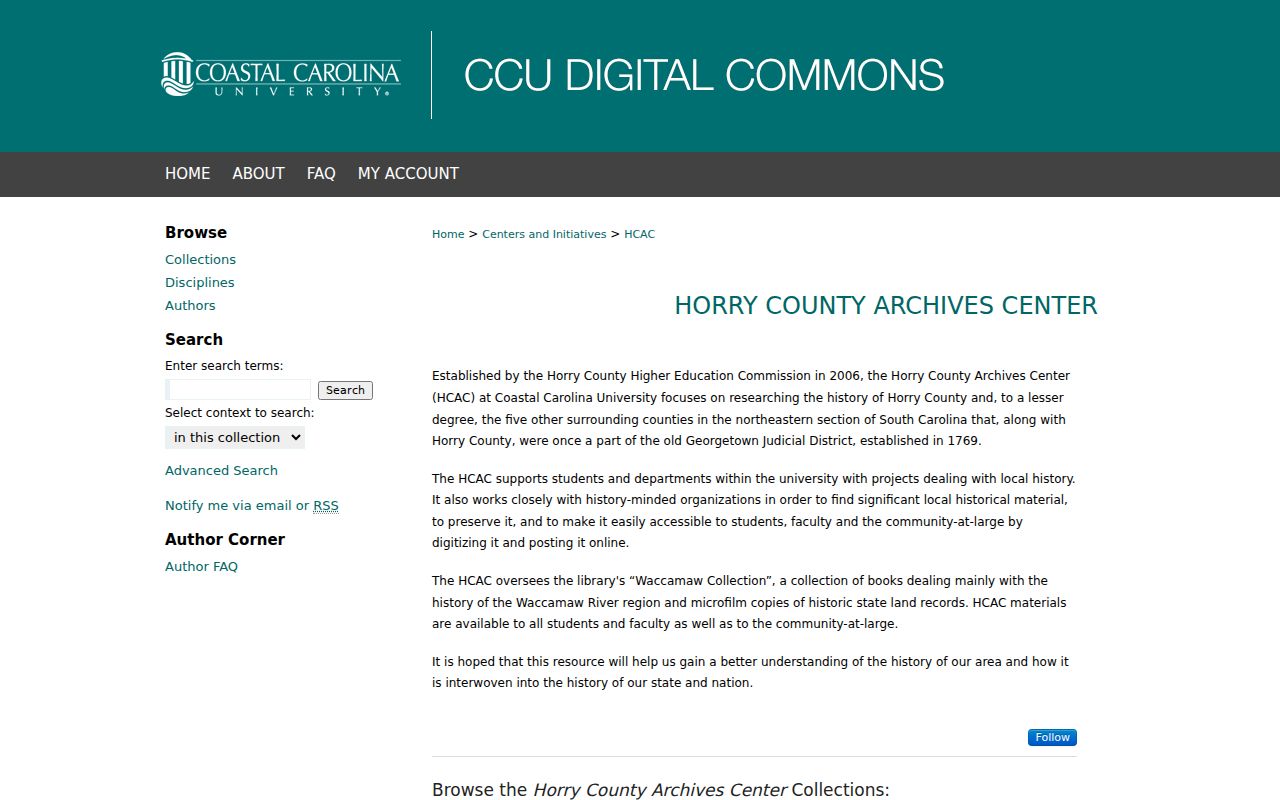
The Archives Center's regional scope can help locate historical context, but dates and parcel identifiers still must connect a record to a specific Conway address.
Past Conway Households Across Records
Owners are only part of the trail. The documented Conway directory years can offer a dated person or business address lead, and census schedules can supply household context. The collections themselves are described on the Conway city directory page; no historical Conway reverse or criss-cross run was verified. Ask a librarian or archivist whether a specific volume has a street-arranged section before relying on one. Pair each directory year with a nearby released census, then test names and places against deeds, probate, and newspapers.
- Find the closest documented directory edition and preserve its title, year, page, and column.
- Check the nearest released census for household composition and spelling variants.
- Use the legal description and deed sequence to keep the address trail attached to the right parcel.
- Check probate files, obituary notices, or other dated records when a person disappears from the trail.
Horry County Historical Society maintains historical newspapers, photographs, oral histories, genealogies, local-history publications, and links to CCU archives. Oral histories can point to a nickname, kinship, church, or neighborhood lead, but a dated directory, deed, census, or probate record should verify it. Horry County Museum directs genealogy researchers to the Historical Society and South Carolina Archives, which helps avoid asking the wrong institution to perform research it does not offer.

Historical Society sources provide useful local context for a Conway household trail when they are paired with a record that has a clear date and custodian.
Conway Previous Residents: Access Limits
Public records do not provide a complete address history for every person. A tax mailing address, deed party, permit application, map feature, and census household describe different facts at different times. The South Carolina Attorney General's Address Confidentiality Program, created by S.C. Code Ann. § 16-25-130, provides eligible participants a substitute address that state and local agencies and courts must accept. It does not erase every already-public record, but it is a clear reason not to promise a complete public trail.
Horry Register of Deeds Recording Notification Service is a free property-fraud-monitoring resource for enrolled names. It is a current safety tool, not a way to reconstruct prior households. Focused requests for nonexempt records can proceed under the South Carolina Freedom of Information Act, S.C. Code Ann. title 30, chapter 4, including § 30-4-30. Recorded deeds, mortgages, and plats have their own Register access route and do not require a FOIA request.
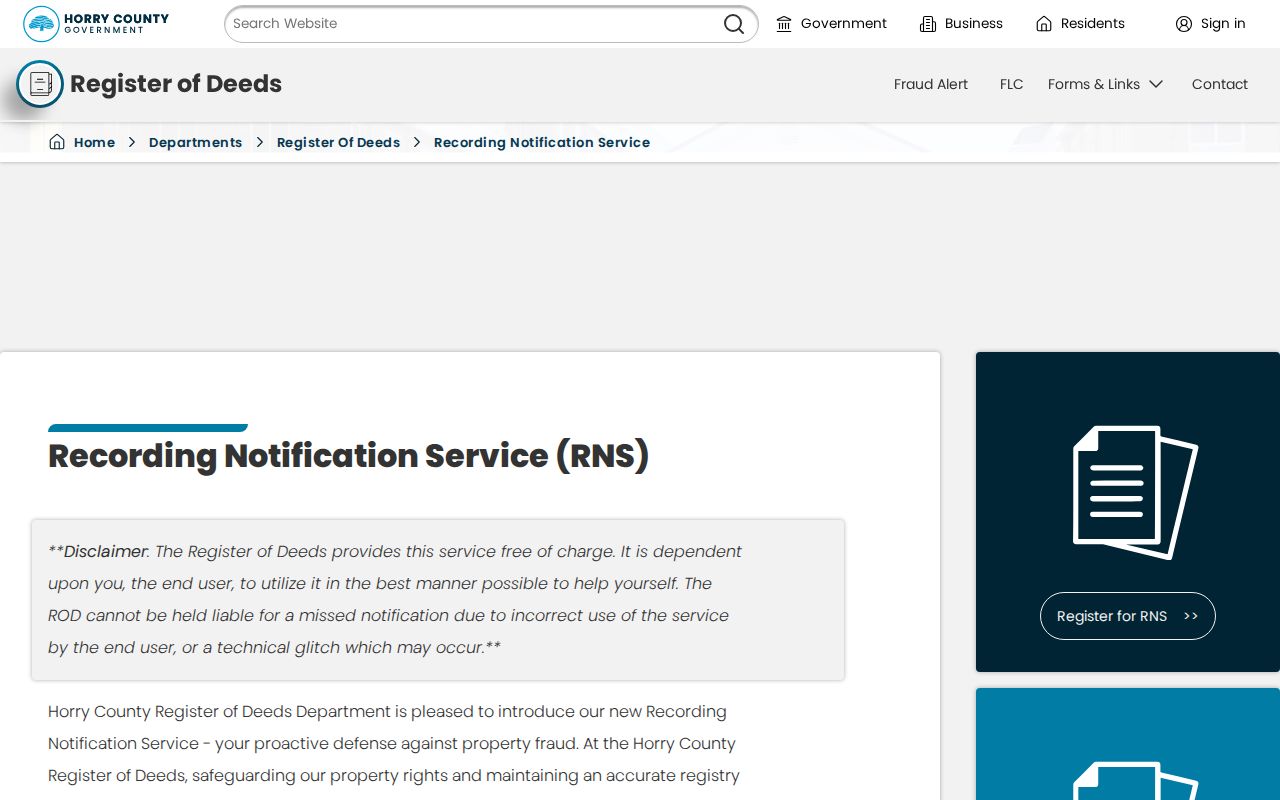
The notification service belongs beside a property-history search as a present-day records safeguard, not as evidence about earlier occupants.
Lawful use. Conway previous-resident research fits family history, house history, estate questions, and personal curiosity. Do not use records to track, harass, or harm a living person.